

Buying Guide
The Best Ice Cream Scoop That Doesn't Stick
Why ice cream sticks to the scoop in the first place - and the one kind of scoop that actually stops it.

The solid steel push design that releases ice cream cleanly. See the Midnight Scoop →
If you searched for an ice cream scoop that doesn't stick, here's the short answer: the scoops that release cleanest are solid, one-piece metal scoops with a smooth bowl and no coating, used with a push motion instead of a dig-and-twist. Heating, gels and batteries are all workarounds for a shape problem. Fix the shape and the sticking mostly disappears.
Below is the why behind that - what actually makes ice cream cling to a scoop, what to look for, and the one scoop we build precisely to solve it.
Why does ice cream stick to the scoop?
Sticking is a temperature-and-texture problem. Your scoop is usually colder than the surface of the ice cream, so the moment they touch, a whisper-thin layer of ice cream refreezes onto the metal. If the scoop has any texture, seam, weld line or non-stick coating, that refrozen layer has something to grip - and now you're prying ice cream off a spoon instead of serving it.
Two things make it worse. A scoop that makes you dig straight down and twist keeps the ice cream pressed against the metal longer, giving it more time to bond. And a scoop that's wet from the last scoop refreezes even faster. So the ideal is the opposite of all that: a smooth, dry, solid surface moved across the ice cream in one quick pass.
Heating the scoop treats the symptom. Fixing the shape removes the cause.
What to look for in a scoop that doesn't stick
- Solid, one-piece metal. No seams or welds for ice cream to catch on, and enough mass to push through hard pints without flexing.
- No coating. Non-stick and painted finishes chip and, ironically, give refrozen ice cream a texture to grab. Bare, smooth steel sheds it.
- A push shape, not a dig shape. A scoop you drive across the surface with your arm releases in one clean curl. A round bowl you jam straight down compacts and sticks.
- No liquid in the handle. Self-defrosting scoops are sealed with a gel that can't go in the dishwasher and eventually stops working. Solid steel has nothing to fail.
- Dishwasher safe. If a scoop can't take a dishwasher, that usually tells you it has a coating or a fluid inside - the exact things that stick and fail.
The best ice cream scoop that doesn't stick
We're a scoop company, so take this for what it is - but the Midnight Scoop was designed around every point on that list. It's solid stainless steel with no coating and no liquid, shaped so you push through even freezer-hard ice cream using your arm instead of your wrist. There's nothing on it for refrozen ice cream to grab, and the push motion means the ice cream spends less time against the metal, so it curls off cleanly instead of welding on.
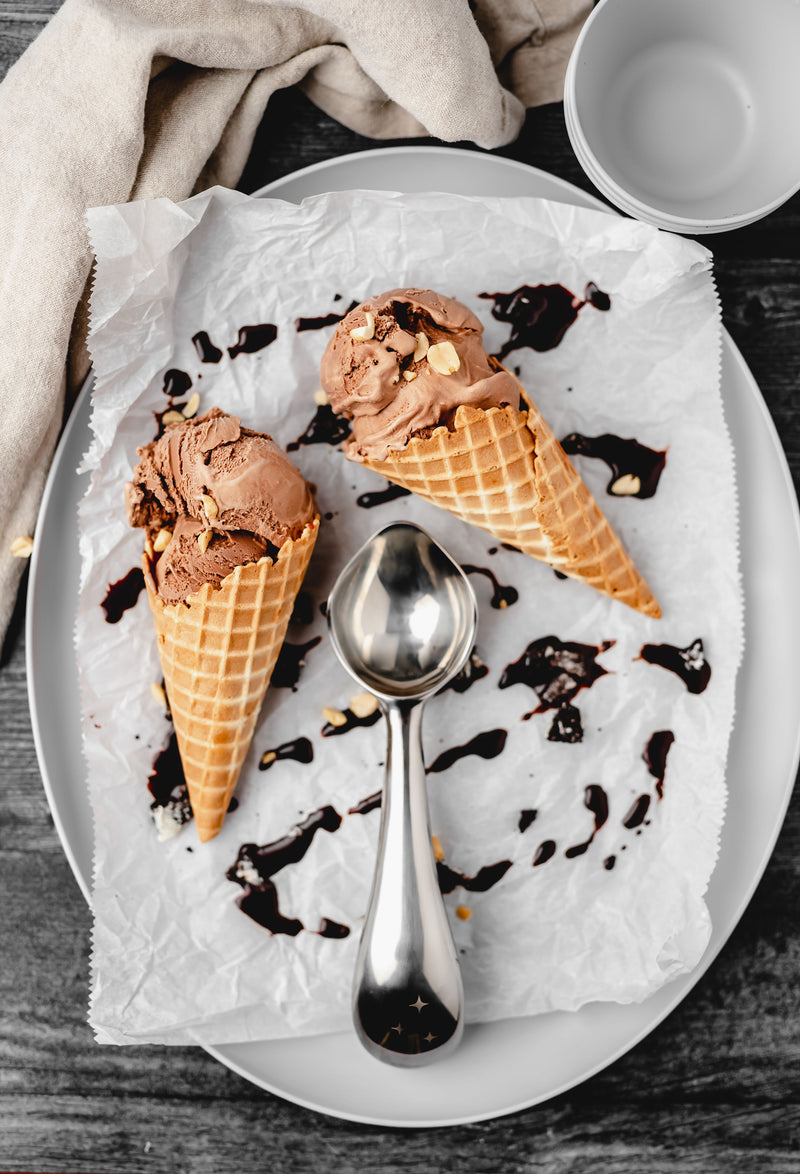
Our pick
Midnight Scoop
Solid stainless steel, no coating, no liquid, no heating. Pushes through rock-hard ice cream and releases in one clean curl. Dishwasher safe, lifetime guarantee.
It also sidesteps the dishwasher trap: because there's no gel and no coating, it goes straight in the dishwasher and comes out fine - which most "no-stick" scoops can't do. If you want the full head-to-head against the best-known name in scoops, we wrote that up separately in Midnight vs Zeroll.
How the common scoop types compare
Every scoop on the market is really one of a few types. Here's how they stack up on the one thing you're here for - releasing ice cream instead of holding onto it.
| Scoop type | Why it sticks (or doesn't) | Dishwasher |
|---|---|---|
| Cheap aluminum / plastic | Flexes and holds texture; refrozen ice cream grabs the surface | Varies |
| Non-stick coated | Coating chips, then grabs worse than bare metal | Often no |
| Warming / liquid-filled | Melts a layer to release - serves softer ice cream, gel can fail | No |
| Trigger / spring scoop | Sweeper helps, but seams and springs trap ice cream and are hard to clean | Varies |
| Solid steel push scoop | Smooth, seamless, no coating; one-pass push gives ice cream nothing to grab | Yes |
How to scoop hard ice cream without it sticking
Even the right scoop rewards the right technique. Three habits do most of the work:
- Give it a minute. Let the tub sit on the counter for one to two minutes so the very surface softens. You're not melting it - just taking the edge off freezer-hard.
- Push, don't dig. Drag the scoop across the surface in one smooth motion, letting the ice cream curl up into the bowl, rather than stabbing straight down and twisting.
- Keep it smooth and dry-ish. A quick warm rinse between scoops helps; just shake it off. A smooth, solid scoop barely needs it - a textured or wet one needs it every time.
Do that with a solid steel push scoop and "sticking" basically stops being a thing you think about.
Frequently asked questions
Why does ice cream stick to the scoop?
Ice cream sticks because the scoop is colder than the ice cream's surface. When they meet, a thin layer refreezes onto the scoop, and any texture, coating or seam gives it something to grab. A smooth, solid scoop driven through in one clean pass gives the ice cream less time and less surface to stick to.
What is the best ice cream scoop that doesn't stick?
A solid, single-piece metal scoop with a smooth bowl and no coating, used with a push motion rather than a dig-and-twist, releases most cleanly. The Midnight Scoop is built exactly this way - solid stainless steel, no coating to grab, shaped to push through hard ice cream in one motion.
Do heated or warming ice cream scoops work better?
A warming scoop melts a thin layer so it releases - but that means serving slightly melted ice cream, waiting for the scoop to heat, and trusting a gel or battery that eventually fails. A solid steel push scoop gets the same clean release through leverage and a smooth surface, without melting anything or waiting.
Can you put an ice cream scoop in the dishwasher?
It depends on the scoop. Liquid-filled, self-defrosting scoops should never go in the dishwasher - the heat can rupture the sealed fluid in the handle. A solid, one-piece stainless steel scoop with no fluid and no coating, like the Midnight Scoop, is fully dishwasher safe.
Does a metal scoop stick less than a plastic one?
Generally yes. Solid metal is smooth, sheds moisture and can be driven through hard ice cream cleanly, so it releases better than most plastic scoops - which flex, hold texture and can crack against frozen ice cream.
How do you scoop hard ice cream without it sticking?
Let the tub sit out for a minute or two, then push a solid scoop across the surface in one smooth motion instead of digging down and twisting. Rinse under warm water between scoops if you like, and shake it off - a wet, textured scoop sticks more than a smooth, dry one.
Stop prying, start scooping
Solid steel, no coating, no heating, no gel to fail - just a clean curl of ice cream, every time.
Shop the Midnight Scoop