

Search for ergonomic scoop data and you'll find three things. Patents asserting a mechanism, brands asserting a benefit, and a handful of ergonomists describing good posture. What you won't find is a number. No force, no wrist angle, no repetitions to fatigue. The food science side of this has been measured rigorously since the early seventies. The human side has barely been measured at all.
What this category actually claims
The mechanism claim in ergonomic scoop design is consistent, and it's old. A 1994 patent for an ice cream scoop with a forearm appendage sets out the problem in its background section. Existing designs concentrate the force of scooping on the operator's wrist. They fail to provide adequate support or stability. The resulting strain and repetitive motion tends to fatigue the operator (USPTO 5,368,465). That filing goes further and names carpal tunnel syndrome as a possible consequence.
How you read that matters. A patent background is written by the applicant to establish that a problem exists worth solving. It's a primary document, it's public, and it's dated, which makes it citable. It isn't a clinical finding. It hasn't been peer reviewed. And the person who wrote it had a direct commercial interest in the problem being real. I'm in exactly the same position, and so is every other brand here.
Later filings repeat the structure of the claim (USPTO 9,173,527, USPTO 5,294,467). Professional ergonomists describe the same principle from the posture side. A curved handle that keeps the wrist closer to neutral lets you push with the palm. That recruits arm and shoulder muscle instead of loading the wrist joint (Taylor'd Ergonomics). Everyone agrees on the story. Nobody has published the measurement.
Two problems that keep getting mixed up
Before any of this can be measured usefully, the question has to be split in two. Scoop designs address one of two distinct problems, and marketing tends to blur both into a single claim about easier scooping.
Adhesion is the ice cream sticking to the bowl of the scoop. Heated-handle designs target this, the ones with conductive fluid sealed inside. Warming the metal reduces sticking at the interface. I've written before about why I don't think warming is the right answer, but the problem it addresses is real.
Force path is where the load goes in your body. Leverage-geometry designs target this instead. Changing the handle angle changes whether the work gets done by wrist rotation or by the forearm and shoulder pushing forward. You can find a fuller explanation of the geometry here.
These aren't competing answers to one question. A scoop can reduce sticking and do nothing for force path. It can change force path and do nothing for sticking.
The other half of this problem has been measured for fifty years
Dairy science has a mature, replicable method for measuring how hard ice cream is. The standard approach uses penetrometry. A 42-gram stainless steel probe with a 60° cone penetrates the sample under gravity for five seconds. Depth of penetration is inversely proportional to hardness (Journal of Dairy Science). Constant-speed penetrometer methods for ice cream texture date back to the early 1970s (Canadian Institute of Food Science and Technology Journal).
That work established which variables drive hardness, with real numbers behind each one. Ice crystal content and size. Fat destabilization. Overrun. The rheology of the mix. If you want the practical version of what that means when you're standing at the freezer, I've covered it in this guide to hard ice cream.
| Side of the problem | Measurement tradition | Published numbers |
|---|---|---|
| The ice cream (hardness, crystals, overrun) | Penetrometry, 50+ years, peer reviewed | Extensive |
| The tool (adhesion, thermal transfer) | Some patent-disclosed data | Sparse |
| The person (force, wrist angle, fatigue) | Essentially none in this category | None found |
The asymmetry is the finding. We know a great deal about the material and almost nothing about the interaction.
What a defensible test would need
This doesn't need inventing from scratch. Repetitive upper-limb exertion already has an international framework in ISO 11228-3:2026, Ergonomics, Manual handling, Part 3: Repetitive movements and exertions of the upper limbs. The ACGIH method it incorporates identifies a threshold limit value by combining Hand Activity Level with Normalized Peak Force. Both are assessed from movement frequency across a work cycle and the duration of the duty cycle.
That gives a scooping study a shape. You'd measure peak force to initiate penetration with a load cell inline with the handle. You'd measure wrist deviation at peak force, in degrees from neutral. You'd count repetitions to self-reported fatigue, which is subjective and has to be reported as subjective. And you'd count scoops per pint and time per pint, because that's the outcome a person actually notices.
It also demands controls that are easy to skip and fatal to omit. Product temperature measured every trial at surface and core. A single named product with stated overrun. Fixed equilibration time. Randomized trial order, so fatigue doesn't load onto whichever scoop went last. More than one operator. One person testing their own product on a warm afternoon is an anecdote with a decimal point.
The protocol, published before the results
Here's what I'm going to run. Publishing it first is deliberate. It means I can't quietly adjust the method after seeing which way the numbers fall.
- Equipment. Load cell inline with the scoop handle, thermocouple for surface and core temperature, video capture for wrist angle.
- Product. One named commercial ice cream, overrun stated, single flavor, bought in one batch.
- Conditions. Fixed equilibration time from a 0°F freezer, temperature logged per trial, same container geometry throughout.
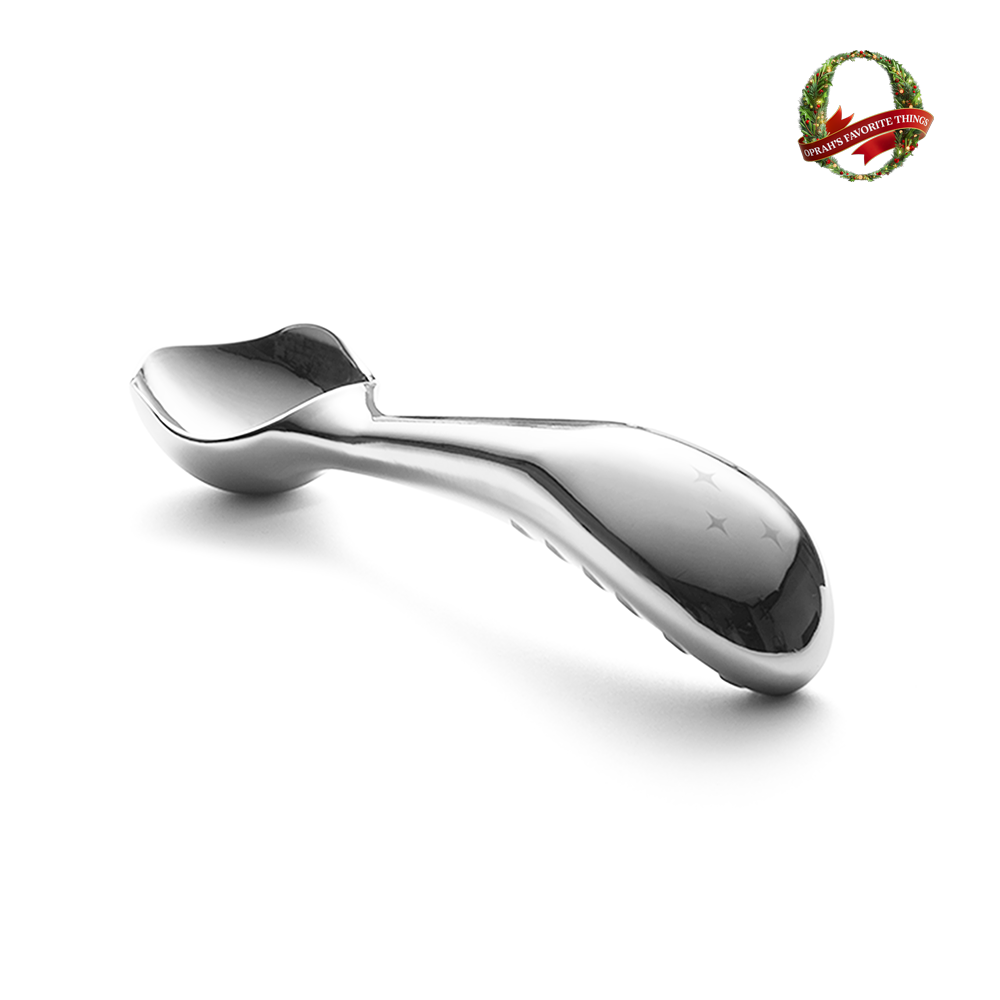
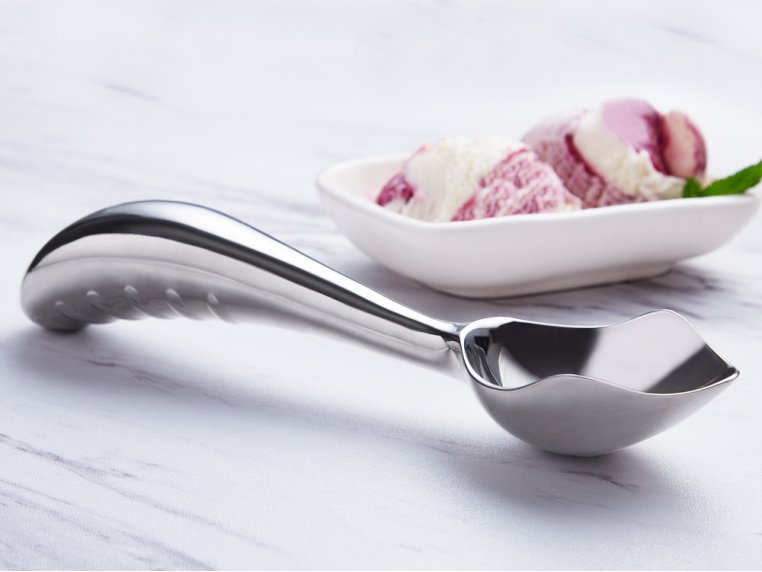
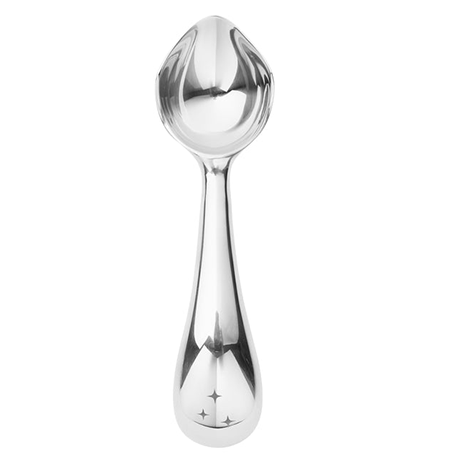
- Scoops. Three designs: a heated-handle conductive scoop, a conventional stainless scoop, and a push-forward leverage design.
- Operators. At least three, varying in hand size and grip strength, with trial order randomized.
- Reporting. Raw table published, not just summary statistics. Sample size stated everywhere. Limitations included.
One commitment attached to all of it. If the push-forward design loses on any measure, that result gets published as prominently as the ones that favor it.
What this won't prove
Plenty, and it's worth being upfront about it rather than tucking it into a footnote later.
It won't be a medical finding. Force and joint angle are mechanical quantities, and nothing in this work will support a claim about injury, arthritis, or carpal tunnel syndrome. I won't make one. The patent language quoted earlier is an applicant's assertion and it stays labeled that way.
It won't be independent either. I designed one of the scoops being tested and I sell it. That's a real conflict of interest, and no amount of protocol discipline removes it. The most useful thing I can do is publish the method in enough detail that someone without that conflict can repeat it and check me.
It'll also be small. Three operators isn't a population. It's enough to detect a large effect and nowhere near enough to detect a subtle one. If the differences between designs turn out to be modest, this study won't resolve them. And it covers one product at one temperature band. Ice cream isn't one material, so a dense super-premium and an airy economy tub won't behave the same way, and results from one won't transfer cleanly to the other.
Frequently asked questions
Is there any published data on how much force scooping ice cream takes?
None that I could verify. Searches turn up pages quoting precise-sounding trial counts and named lab equipment, but without traceable methodology or a citable source document. Ice cream hardness itself is thoroughly measured in the dairy science literature. The force a person applies to it isn't.
Does a heated-handle scoop reduce the effort?
It reduces sticking, which is a genuine and separate problem. Whether it changes the force needed to penetrate cold ice cream, or where that force lands in your arm, is exactly what hasn't been measured.
Why does this need a standard like ISO 11228-3?
Without a recognized framework, any result is just a brand's own number. ISO 11228-3:2026 defines how repetitive upper-limb exertion gets assessed. That makes a study's design reviewable by someone who wasn't involved in running it.
Are you claiming your scoop is better?
Not in this article. I'm claiming the category has never tested the question properly, mine included, and I'm publishing how I intend to test it.
When will the results be published?
On this blog, whenever the trials are complete, with the raw table included. If the protocol changes between now and then, I'll say what changed and why.
What happens next
I'll run the protocol as written above and publish whatever comes out of it. In the meantime the honest position is the one I started with. The mechanism argument in this category is old, widely repeated, and unmeasured, and my product rests on it like everyone else's does.
If you test this independently, I'd rather read your numbers than my own.
Michael Chou is an aerospace engineer and the founder of Midnight Kitchen Tools. He designed a push-forward ice cream scoop and holds a patent on its geometry, which is a conflict of interest relevant to everything above.